Skip to content
All projects
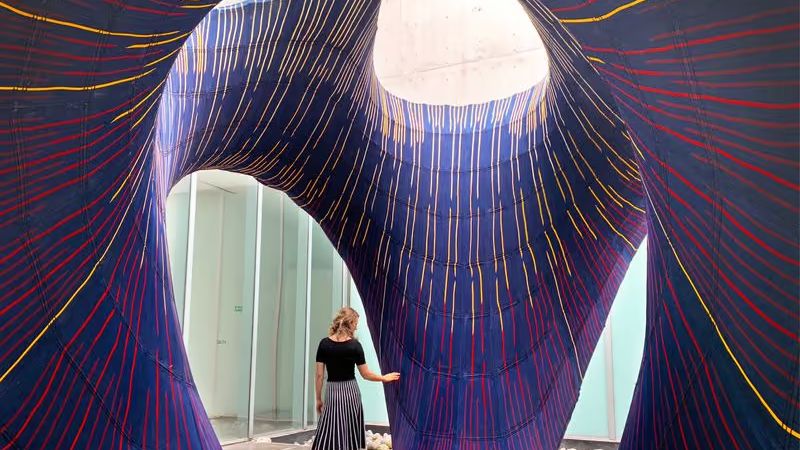
A woman standing inside a sweeping concrete shell lined with a purple knitted textile

KnitCandela

MUAC, Mexico City · 2018 · Block Research Group, ETH Zurich, with ZHA CODE

A thin, sinuous concrete shell built on a knitted formwork that travelled from Switzerland to Mexico in a suitcase.

KnitCandela was built at the Museo Universitario Arte Contemporáneo in Mexico City for the first exhibition of Zaha Hadid Architects in Latin America. It is an homage to the shell builder Félix Candela, reimagining his concrete shells through new computational design methods and KnitCrete, a CNC-knitted formwork technology. The whole formwork weighed 55 kg and was carried to Mexico in a suitcase.

How COMPAS was used

The shell was form found with compas_fofin, the COMPAS package for form finding of cable nets and shells.
More made with COMPAS

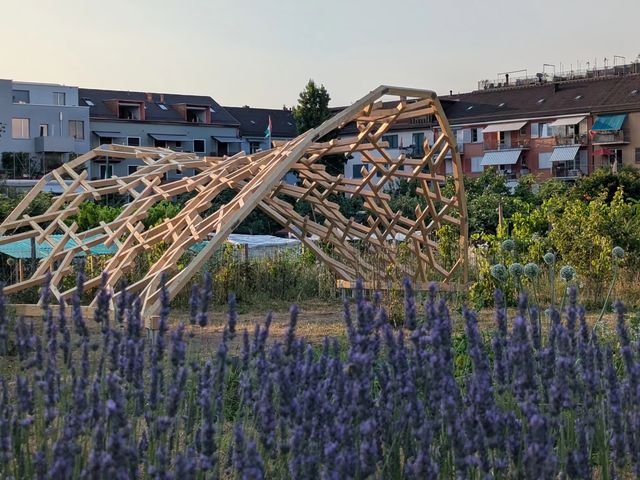
  • A leaf-shaped lattice of timber beams arching over a community garden at golden hour, with lavender in the foreground and apartment buildings behind

    HARDLEAF

    Quartiergarten Hard, Zürich, Switzerland · 2026

    A leaf-shaped timber pavilion of 182 beams for a neighbourhood garden, designed and built by students, with kiwi plants growing over it for shade.

    Coding Architecture II, Gramazio Kohler Research, ETH Zurich · Photo: lisdem

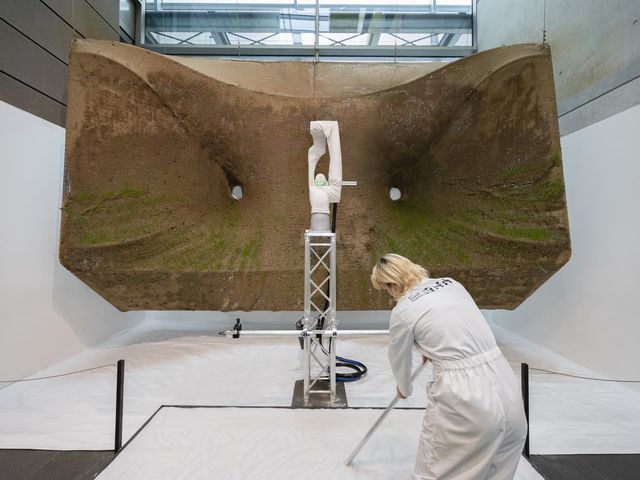
  • A robot arm on a truss in front of a large suspended net sprayed with soil and sprouting grass, while a person in a white overall draws in sand

    Sybil

    Ars Electronica, Linz, Austria · 2026

    Visitors draw in sand, and a robot turns their traces into toolpaths, spraying soil and seeds onto a suspended net that grows into a living surface.

    Architecture and Human Augmentation, ETH Zurich · Photo: Zita Oberwalder

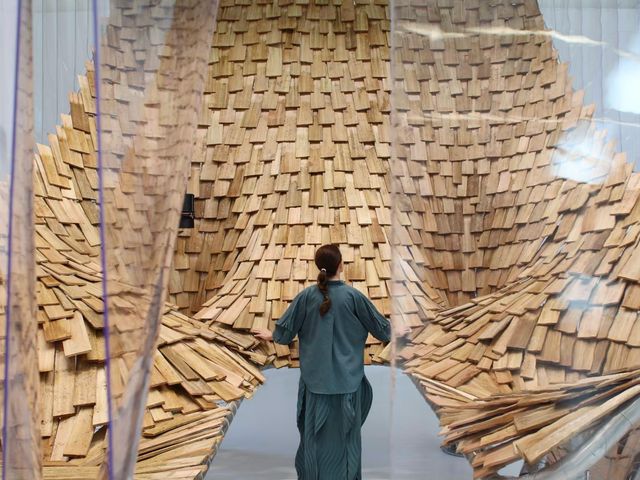
  • A visitor stands inside a sweeping, curved landscape of overlapping wooden shingles, seen through translucent hanging curtains

    Dafne's Skin

    Triennale Milano, Milan, Italy · 2025

    An enlarged fragment of skin from the myth of Dafne, made of wooden tiles, whose surface slowly changes under a robotically applied living patina.

    Architecture and Human Augmentation, ETH Zurich, and MAEID · Photo: Zita Oberwalder

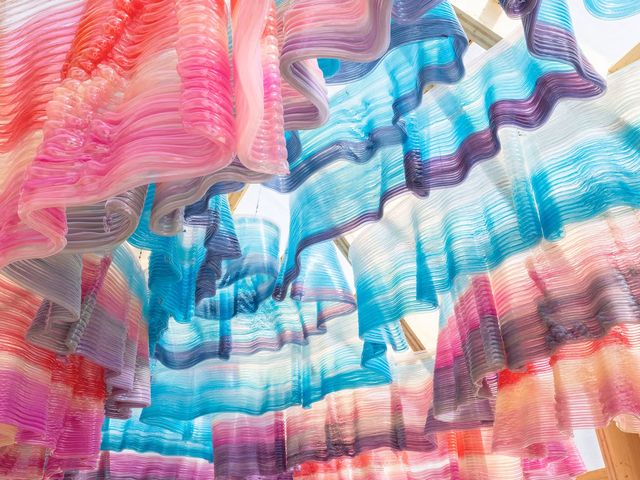
  • Looking up into a cupola of ruffled, translucent plastic layers in pink, blue and purple, printed as hollow tubular beads

    Gelateria Mulegns

    Mulegns, Switzerland · 2025

    An ice cream shop next to Tor Alva, under a cupola robotically printed from recycled plastic: 250 square metres that weigh less than a tonne.

    MAS ETH DFAB and Digital Building Technologies, ETH Zurich · Photo: Stefan Kaiser