Fluid Forms
ETH Zurich, Switzerland · 2022 · Digital Building Technologies, ETH Zurich
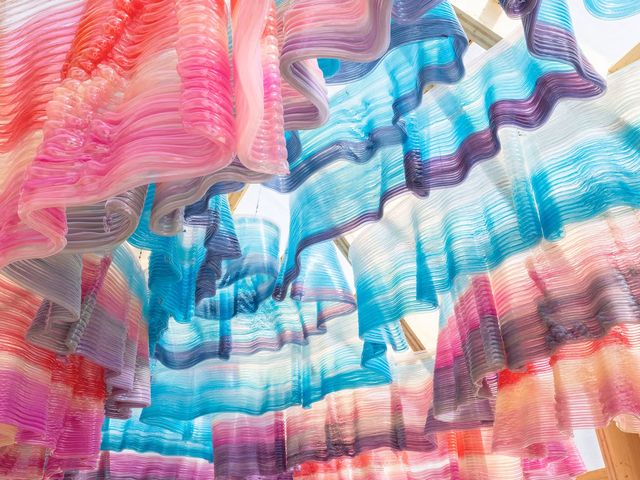
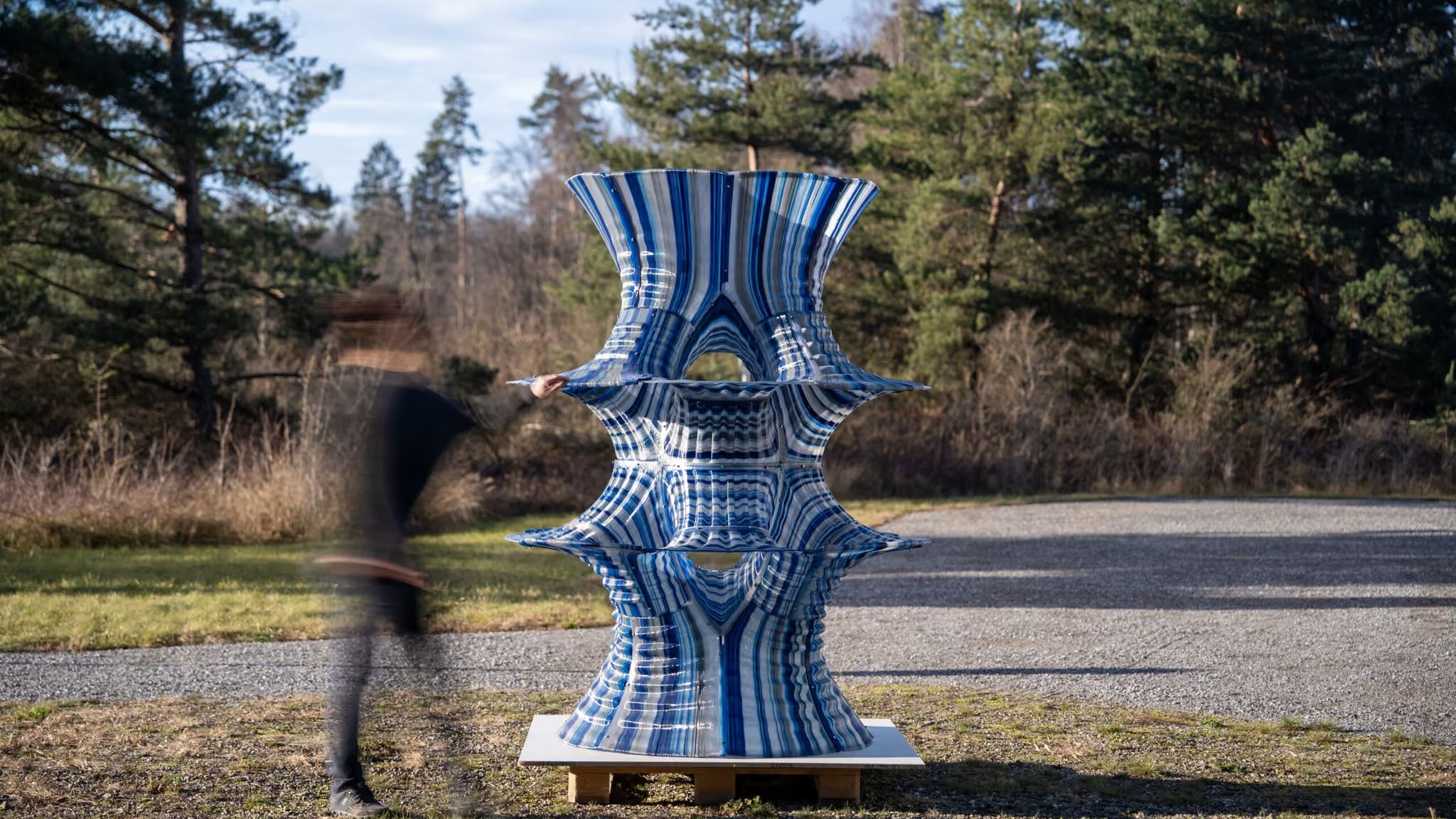
A two-metre shell of translucent, blue-streaked plastic, robotically 3D printed along curved, non-planar paths that follow its principal curvatures.
Fluid Forms is a lightweight shell, two metres tall, inspired by the Costa minimal surface. Instead of stacking flat layers, a robot printed it along non-planar paths aligned with the surface's principal curvature directions, steered by a vector-field optimisation tuned to the constraints of the process. Printing this way needs less sacrificial support and gives better precision and surface quality where the shell curves sharply, while undulations across the print direction stiffen it. The 40 parts, in translucent PETG mixed with blue and silver, are screwed together so the shell can be taken apart and recycled.
How COMPAS was used
The non-planar print paths were generated with COMPAS Slicer. Fluid Forms was one of the projects that led Ioanna Mitropoulou and Joris Burger to develop COMPAS Slicer, the COMPAS package for slicing geometry into print paths for robotic 3D printing.